Marili Andre Catches Fashion in the Middle of a Scene

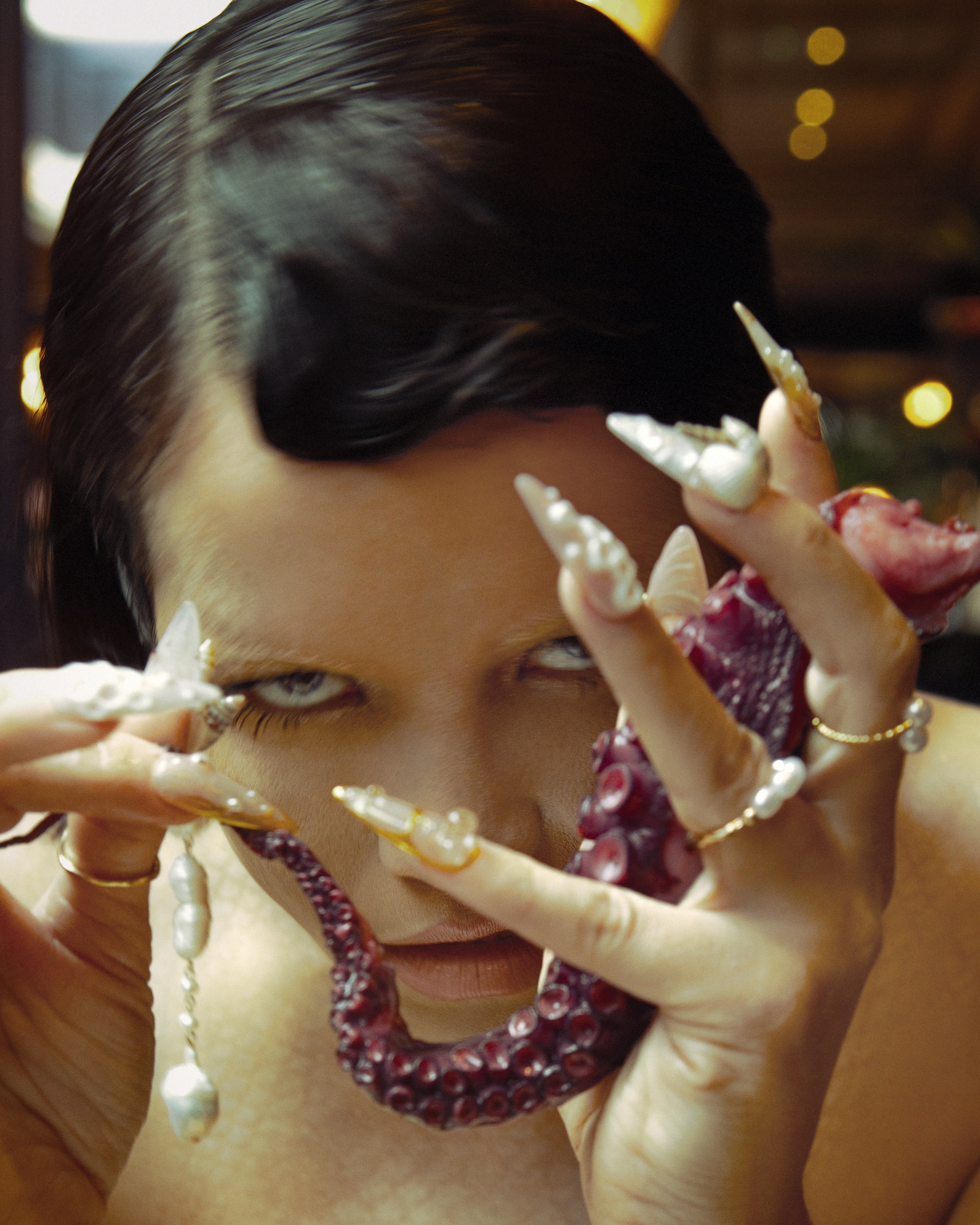
Marili Andre builds a fashion picture outward from one thing. It might be a face or a piece of clothing that suggests how someone should move. In her Art Partner profile, the Greek-born, London-based photographer connects that way of working to cinema and to the suspense of finding out what a picture can become. It’s a practical way to talk about an image that feels as though it has reached us in the middle of something. The first thing the viewer finds may be the reason the scene began. Everything around it threatens to change what it means.
For Robyn’s “Dopamine,” Andre had to make a still stand next to a performance. The single artwork, credited to Andre in The Label’s release, is a close-up of an eye. A transparent circle draws attention inward while the skin and brow keep their detail almost to the edge. A cover that would usually give the viewer a whole face asks one part to hold the recognition. The music video gets to return that face to a body in motion.

For a version of that process with the scene allowed to run, there is the official music video Andre directed for Robyn’s “Dopamine.” Art Partner lists it alongside her editorials and campaigns. Near the front of the image is a performer who can hold the viewer’s attention while the conditions around her change. The camera repeatedly finds its way to the body as ribbons of light, flying sparks and dark intervals change what can be seen around it. The performance gives a sensation of what a fashion photograph can only imply, the ability to get a person back into focus after the frame has made them difficult to follow.
The transition between still and moving work is useful because it separates suspense from the trappings of cinema. A fashion picture can borrow a dramatic color or a costume and end there. A face whose attention seems to have moved out of the frame gives the image something else. The viewer has to decide what the person has seen and whether we have arrived in time to see it. A film like this one tests that kind of attention for more than a few seconds.
Fashion photography also has the awkward job of showing something clearly enough for viewers to identify it. Andre’s work has room for that demand. Art Partner lists Miu Miu Spring 2024 and Marc Jacobs Beauty alongside editorials for Double, POP and The Face. Take the small distance between advertising and an editorial when you come to one of those photographs. The viewer might recognize the dress or lipstick immediately, and the person can still appear occupied with the rest of their life.
In a separate publicity portrait of Robyn, Andre leaves a blue-gray field around the singer’s shoulders and platinum hair. The body is turning away from the lens and the eyes have come back to meet it. It takes a wider frame than the single cover to give that turn its shape. Look at the portrait after the film and the movement feels as though it could continue after the shutter.

A finished image can lead a viewer to credit all of its decisions to whichever name appears first. The Zara 520 campaign’s production credits keep the work in view at a different scale, listing Andre as photographer, Dufu as cinematographer, and Zhoutong as hair and makeup artist. The more useful way to recognize a director who likes to work from one thing is to ask how many people helped decide what could surround it.