
Inside a latex-laced collaboration where mythology, nightlife, and authorship collide.
There are models who enter a photograph politely, as if asking permission from the frame. Tessa Kuragi is not one of them. She arrives with the composure of someone who understands exactly what the camera wants and, more importantly, what it cannot control.
That distinction is subtle but powerful. In fashion imagery the camera is often treated like an authority. It defines beauty, posture, mood. The subject obeys. Kuragi operates with a different understanding. She treats the frame less like a container and more like a stage, something to push against, something to test.
The result is a presence that feels composed but slightly dangerous. Scroll through her work long enough and the pattern becomes clear. Kuragi does not simply inhabit images. She negotiates with them. One moment she appears statuesque, almost classical in posture. The next she punctures the illusion with a glance that reads as half amusement, half challenge.
The camera watches her, but she is clearly watching it back. This editorial collaboration expands that tension into something closer to character creation. The concept, described by Kuragi as a bar-mermaid or siren fantasy, draws from one of the oldest archetypes in storytelling. Sirens exist in the strange territory between beauty and threat. They attract attention without asking for it, and by the time the observer understands what is happening, the observer has already lost control of the moment.

In mythology, sailors never stood a chance. In photography, the dynamic becomes more interesting. The visual environment surrounding Kuragi here is constructed by London photographer Paul Artemis, whose monochrome editorial work has built a quiet following for its sculptural lighting and stripped compositions. Artemis photographs bodies the way a sculptor studies marble. Lines matter. Negative space matters. Shadow becomes architecture rather than background.
The approach sits somewhere between classical portraiture and modern underground fashion photography. You can see echoes of Helmut Newton’s stark confidence and the minimal drama of late twentieth-century studio portraiture, but Artemis avoids imitation. His images carry a colder restraint.
He removes visual noise until posture becomes narrative. When Kuragi enters that environment the frame stops behaving like fashion photography and starts behaving like portraiture with teeth.

One image captures the shift perfectly. Kuragi stands in latex under hard studio light, body angled with the deliberate stillness of a classical statue. The material catches the light so sharply that it reflects like black glass. Her shoulders are squared, chin slightly tilted, the pose controlled enough to feel sculptural. Yet the expression on her face reads like someone privately amused by the entire spectacle unfolding around her.
The power dynamic flips, you begin to realize that the photograph exists because she allows it to.
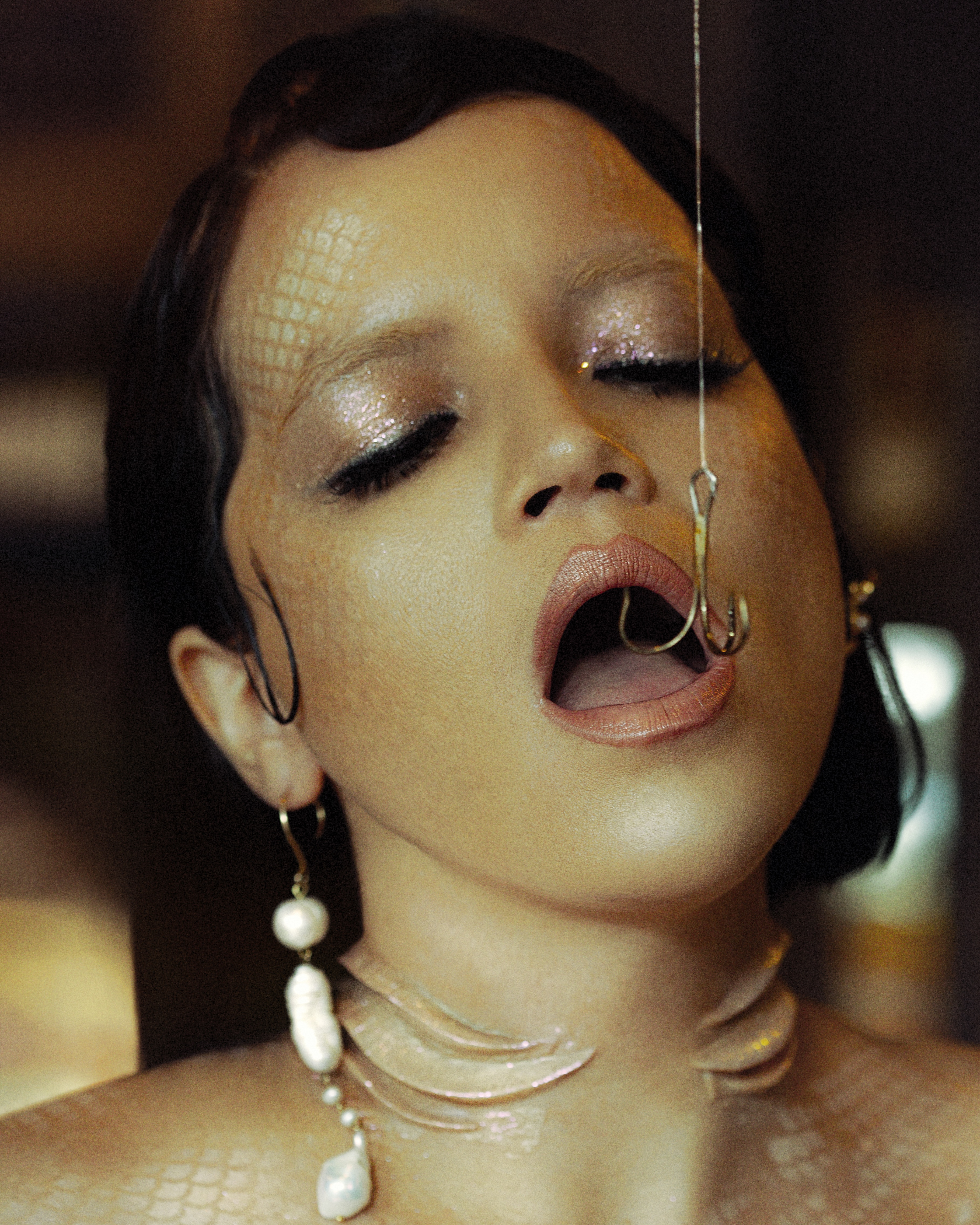
The transformation into this aquatic-nightlife hybrid character is pushed further through the work of makeup artist Milena Watts, who introduces one of the shoot’s most quietly unsettling details: prosthetic gills placed along Kuragi’s neck. They are subtle enough to escape immediate notice. Then the eye returns to them and the illusion shifts.
The model becomes something slightly nonhuman. Watts works in the territory where beauty makeup and prosthetic design overlap. The gills do not scream fantasy. They whisper it. The effect feels less like costume and more like evolutionary evidence of a creature that might plausibly exist somewhere between mythology and late-night city life.

A siren who traded the ocean for neon and bar stools. The tactile storytelling continues through the hands, where Serenius Nail contributes sculptural metallic nail work that feels closer to wearable weaponry than conventional beauty styling. The shapes echo aquatic textures and predatory elegance at the same time. Long, reflective, slightly aggressive.
Hands that could either caress the moment or scratch the illusion apart.
Wardrobe pushes the mythology further into fetish territory, which is exactly where the shoot becomes culturally interesting rather than merely aesthetic. The corset and skirt come from Torture Garden Latex, a brand tied to London’s legendary Torture Garden club and its decades-long influence on fetish fashion culture. For years that scene has quietly fed visual ideas into high fashion while rarely receiving credit for it.
Latex is a material that refuses subtlety. It reflects light like oil on water. It compresses the body into exaggerated geometry. It carries a cultural history that moves between underground nightlife, performance art, and couture experimentation. Under Artemis’s lighting the surface becomes almost metallic, turning Kuragi’s silhouette into something closer to armor than clothing.
Somewhere between nightclub mythology and ceremonial costume. The final piece completing the character is a custom latex fin belt by SHHH Couture Latex, a designer known for sculptural latex garments that reshape the body’s natural lines into something surreal. The belt introduces the suggestion of aquatic anatomy without abandoning the human form.

A hint of tail, just enough to complete the illusion.
Taken together, these elements construct a visual mythology that feels strangely coherent. Kuragi becomes the siren not through theatrical exaggeration but through the slow stacking of details. Latex becomes skin. Nails become claws. Prosthetics become biology.
The transformation happens quietly, which is exactly how mythology tends to work. What ultimately gives the images their charge, however, is not the styling or the concept. It is Kuragi’s awareness of the performance unfolding around her. She carries herself with the composure of someone who understands the strange economics of image culture.

Attention is the real currency, and the people who control it rarely look like they are trying. Kuragi moves through the shoot like someone fluent in that language. Her expressions drift between seduction, mischief, and something closer to intellectual curiosity. She seems amused by the spectacle while simultaneously commanding it.
That balance is difficult to fake. Fashion photography has historically depended on a simple hierarchy. The photographer directs. The stylist constructs. The model performs. The digital age has quietly dismantled that structure. Models today are often collaborators, sometimes even authors of the mythology surrounding their own images.

Kuragi embodies that shift. She does not appear overwhelmed by the camera’s gaze. She manipulates it. She allows it to exist in the space around her rather than dominate it. Which brings us back to the siren metaphor. Sirens never chased attention. They simply existed so intensely that attention reorganized itself around them.
Tessa Kuragi operates in much the same way. The viewer looks because the image is beautiful, then they look again because something inside the photograph feels slightly dangerous.
And somewhere between those two moments, the editorial reveals its real subject. Not just fashion. Not just beauty. But the evolving relationship between power, performance, and authorship in an age where images move faster than intention.
Kuragi does not merely pose for the camera, she collaborates with it. And sometimes, if you look closely, she outsmarts it in the best way possible.

CREATIVE TEAM
Model
Tessa Kuragi
Photographer
Paul Artemis
Makeup & Prosthetics
Milena Watts
Nail Artist
Serenius Nail
Latex Corset & Skirt
Torture Garden Latex
Custom Latex Fin Belt
SHHH Couture Latex
FEATURE LINKS
Tessa Kuragi
https://www.instagram.com/tessa_kuragi/
Paul Artemis
https://www.instagram.com/paulartemis3/
Serenius Nail
https://www.instagram.com/sereniusnail._/
Torture Garden Latex
https://www.instagram.com/torturegardenlatex/
SHHH Couture Latex
https://www.instagram.com/shhhcouturelatex/