
THE ARTIST HACKING AI, AESTHETICS, & YOUR ALGORITHM ONE CRYPTID AT A TIME
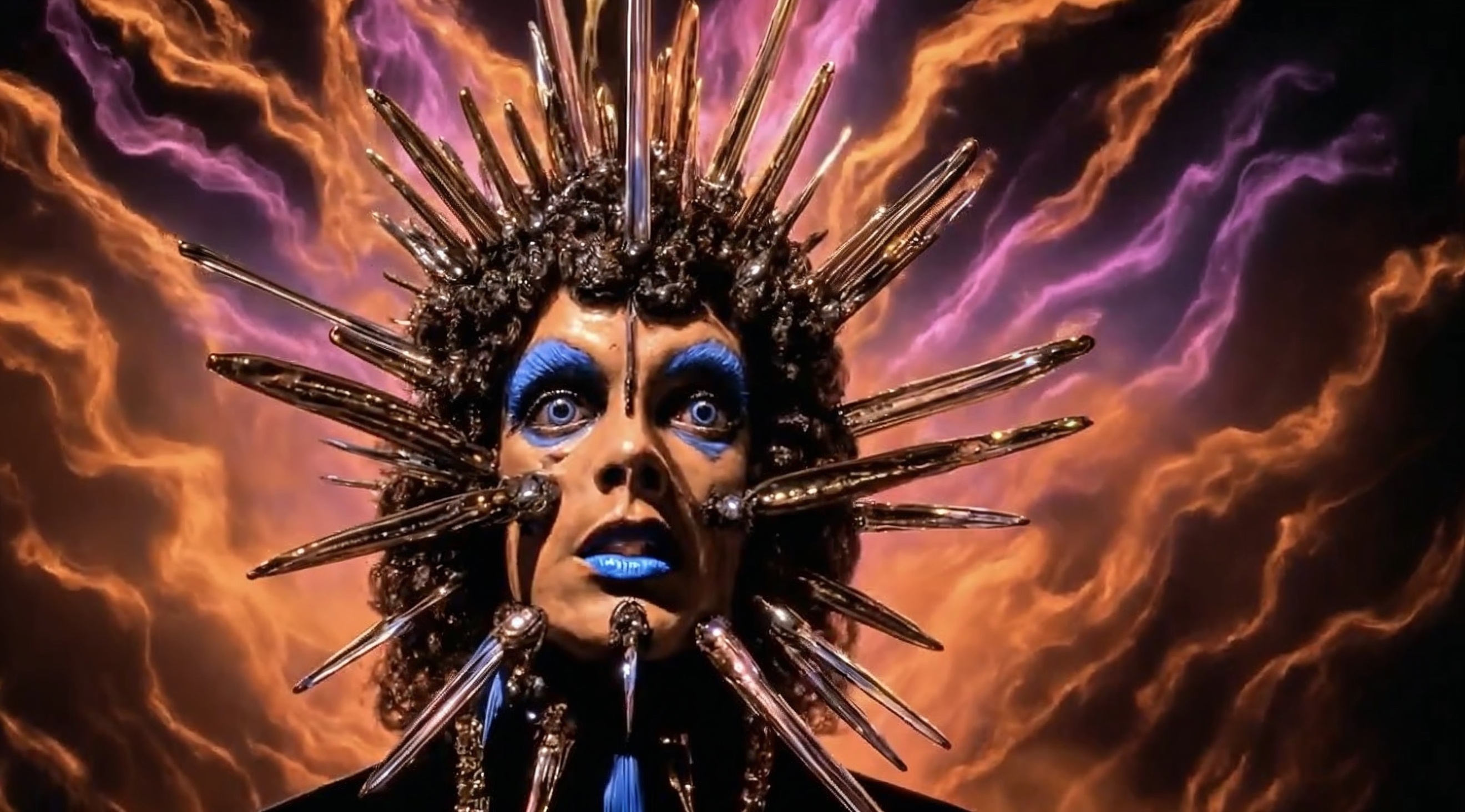
BLVCKL!GHT, stylized with a battle cry of an exclamation mark, isn’t just an artist. He’s a multi-dimensional entity surgically maneuvering between corporate boardrooms and generative hellscapes, and somehow making both look equally punk. If you try to box him into a single discipline, you’ll get left in the digital dust. Images. Animations. Music videos. Entire goddamn universes that look like Pixar got possessed by Dario Argento and funneled through an NVIDIA stack on Adderall. This Portland-based force of AI artistry doesn’t sleep. He executes.
By daylight, he’s a nationally recognized marketing exec with a decade-plus of SaaS and digital strategy under his belt. But once the suits come off, the monsters come out. He’s self-taught, internationally exhibited, and award-winning, yet still somehow flying just low enough under the radar to stay dangerous. What gives him the upper hand? It’s not just talent, it’s infrastructure. He knows how to position, protect, and push IP in a world that’s barely caught up to what AI is doing to art.

The work that catapulted him from cult status to full-blown online legend was Cryptid Dating Game.. a twisted, claymation-esque series where grotesque, uncanny creatures thirst and flirt in an absurdist parody of reality TV. Created entirely solo using generative AI, the series blends surreal horror and viral hilarity with worldbuilding that doesn’t just invite curiosity, it demands obsession. Reddit threads lit up. TikTok feeds got devoured. Tens of millions of views later, BLVCKL!GHT had effectively proven that AI art could not only live on short-form platforms — it could thrive there.
And unlike many digital artists stuck in their aesthetic comfort zones, he refuses to stagnate, always experimenting and evolving. While the claymation-horror vibe built his cult following, BLVCKL!GHT is already onto the next mutation. Newer work veers into varied palettes, narrative structures, and visual experiments that would make any AI model sweat. He’s spoken openly about the dangers of becoming a gimmick in your own genre, something every artist should be conscious of, and the importance of iteration, branching out, and not pandering to the algorithm gods. If that means letting go of what made you popular? So be it.
The Machine Cinema podcast, where BLVCKL!GHT dropped his philosophies like grenades, underlines his core strategy: lean into the “slop.” Those messy, half-rendered weirdlings that most AI artists delete before they breathe? He embraces them. Builds from them. That off-kilter jank you think is a glitch? He’ll make you love it.

He’s not afraid to talk business either. Because this is where the dual life kicks in: BLVCKL!GHT understands brand collaboration, long-term IP building, and how to price art in a way that keeps the power in the creator’s hands. In the same Machine Cinema episode, he dives into the “pricing paradox” of AI, how tools aren’t free, time has value, and creators need to stop treating AI work like a cute side hustle. Hardware, GPU credits, and subscriptions bleed your wallet dry if you’re not charging appropriately. Cheap tools? They often cost you more in ethics and integrity.
And ethics do matter here. BLVCKL!GHT doesn’t use AI to replicate. He uses it to create. He’s outspoken about training data transparency and draws hard lines around copying others’ work. In a time when everyone’s mimicking everyone else for clicks, his stance is revolutionary: augment human creativity, don’t erase it. If your AI is making the work soulless, that’s not the machine’s fault, it’s yours.

His TikTok isn’t just a gallery; it’s a goddamn lab for the inspired mind. For BLVCKL!GHT, platforms like TikTok and X aren’t marketing tools, they’re experimental spaces for audience interaction. Dialogue is the point. If your art can’t live in the comment section, if it doesn’t inspire lore-building, speculation, and community theories, is it even alive?
Community is the oxygen that keeps this weird engine running. He’s collaborative, open about process, and quick to encourage newcomers, not gatekeep them. His approach to sustainability is refreshingly un-precious: share what you know, lower costs through collaboration, build your scene or die waiting for one.
Behind all the freaky monster faces and generative psychedelia is a guy who understands that stories sell, but trust sustains. He doesn’t just want to ride the AI wave, he wants to architect the future of media where AI, human creativity, and authentic storytelling collide. AI is not the next internet, he says. It’s the next medium. And how you wield it? That’s what separates the artists from the art influencers.
BLVCKL!GHT is already thriving in this liminal space, part visionary, part tech whisperer, part madman with a GPU and a dream. The mainstream press may still be figuring out how to spell his name, but that’s fine. They’ll catch up, if he lets them.
We got the chance to sit down with the man himself to let him tell you his thoughts on everything, instead of us just rambling on like a kid on the playground hopped up on too much sugar and bad ideas, haha.. (SEE BELOW)

@blvcklightai 💕 TONIGHT ON INTERDIMENSIONAL TV 💕 CRYPTID DATING GAME | 10PM DIMENSION X-72 When your exes keep disappearing under mysterious circumstances, maybe it's time to cut out the middleman! Tonight, contestant Gary Schmargle (survivor of three cryptid-related relationship disasters) chooses between Mothman (disaster prophet with his own condo), a shapeshifting Skinwalker with boundary issues, and the recently divorced Jersey Devil. Will Gary find love before the studio collapses? Will Damien's unexpected physical transformations finally be acknowledged? Can the Jersey Devil find someone who appreciates his blueberry pancakes? VIEWER ADVISORY: The Skinwalker may have already replaced someone in your household. Check for family members with too many teeth. #CryptidDatingGame #InterdimensionalTV #MothmanIsBF #DateWhatTookYourEx #interdimentional #adultswim #blvcklightai #FindMelissa #MissingTuesday #MonsterMatch #CryptidDatingGame ♬ Cryptid Dating Game Theme Song – BLVCKL!GHT
“And if you think Cryptid Dating Game was the endgame, think again. BLVCKL!GHT’s next descent into madness is already locked in: Whispers in the Dark 2: Digital Purgatory. A month-long, interactive, out-of-order mystery that drops daily episodes like breadcrumbs through a haunted maze, all leading to his fourth feature-length film premiering on Halloween. Each day a new episode, each one stitched into a final, fever-dream opus. Enter if you dare: whispers-in-the-dark.tv/next“

EXCLUSIVE INTERVIEW /. BLVCKL!GHT
You describe yourself as a self‑taught, internationally exhibited AI artist who also works as a marketing executive. How did your background in marketing and your previous artistic pursuits inform your entry into AI art?
My marketing background fundamentally shaped not just my approach to creating art, but how I think about building an entire creative brand ecosystem. When I first dove into AI art, I treated it like any major campaign launch; I gave myself a deliberate 90-day testing period focused purely on stylization and finding my authentic voice while mastering the technical tools.
This methodical approach was crucial because AI art can be overwhelming at first. There are infinite possibilities, which can paradoxically lead to creative paralysis. My marketing experience taught me the importance of constraints and focused testing. I experimented with different aesthetics, studied what resonated with audiences, and most importantly, what felt true to my creative vision. Once I identified what my brand focus would be (that intersection of horror, surrealism, and nostalgic weirdness) everything else started falling into place organically.
The framework thinking from marketing gave me structure, but my previous artistic pursuits provided the soul. I’ve been creating since childhood: piano at age five, then photography, painting, writing, and music throughout my life. AI became this incredible amplifier for all those accumulated creative skills and instincts. Instead of starting from scratch, I was building on decades of artistic intuition, just with radically new tools.

Developing a Signature Style
Your work often combines horror, surrealism and claymation‑like characters. What drew you to these aesthetics, and how did you arrive at the Cryptid Dating Show concept?
I’m absolutely a product of the ’80s and ’90s, and that era’s fearless, boundary-pushing creativity has been my North Star. There was this incredible “no rules” energy in content creation back then… shows like Ren and Stimpy and Pee-Wee’s Playhouse that were simultaneously childlike and subversive, beautiful and grotesque. That aesthetic DNA runs deep in my work.
My musical influences have been equally formative. The Grateful Dead, The Doors, Pink Floyd… these artists created immersive sonic worlds that transported listeners. Then you had the grunge movement with its “fuck the establishment” ethos that taught me authenticity trumps perfection every time. I wanted to channel that same energy into visual storytelling.
The claymation aesthetic emerged naturally because it bridges that sweet spot between nostalgic and unsettling. There’s something deeply comforting about the tactile, handmade quality of clay animation, but when you push it into surreal territory, it becomes genuinely unnerving in the best way.
Cryptid Dating Game specifically crystallized during my exploration phase when I was thinking about game shows I grew up watching… The Match Game, The Dating Game, Love Connection. These shows had this perfect blend of manufactured romance and genuine awkwardness that felt ripe for subversion. When I started thinking about cryptids as contestants, it clicked immediately. Here were these mysterious, misunderstood creatures looking for connection, just like the rest of us. The concept let me explore themes of loneliness, acceptance, and what it means to be “normal” while wrapping it all in vibrant, chaotic entertainment.

The TikTok Phenomenon
The Cryptid Dating Show series quickly went viral, with viewers praising its uncanny art style and unfolding lore. What role did TikTok play in growing your audience, and how do you craft narratives for short‑form platforms?
TikTok has been the ultimate creative boot camp, and honestly, the best teacher I never knew I needed. Unlike Meta platforms where you can sometimes game the algorithm if you know the tricks, TikTok’s algorithm is beautifully ruthless and unpredictable. It forced me to focus on pure creative merit rather than marketing hacks.
I spent about eight months in what I call my “wilderness period” posting daily, consistently getting 200-300 views, watching other creators blow up while I stayed stagnant. The marketing executive in me knew exactly what I was doing “wrong”: I was posting 16:9 instead of 9:16, creating medium-form content instead of quick hits, ignoring all the conventional wisdom about viral content.
But here’s the thing: that “failure” to comply with the rules was actually my secret weapon. When I finally broke through TikTok’s algorithm, it was precisely because my content was distinctive and uncompromising. The platform rewarded authenticity over optimization, and suddenly I had this audience that genuinely connected with the weird, specific world I was building.
Crafting narratives for short-form platforms requires thinking like a novelist and editing like a haiku poet. Every frame has to advance either plot or character development. I’m constantly asking: what’s the emotional hook in the first three seconds? How do I pack maximum lore into minimum time? How do I leave viewers with just enough questions to keep them coming back?
The beautiful thing about serial content like Cryptid Dating Game is that each episode can be both self-contained and part of a larger mythology. Viewers can jump in anywhere, but longtime followers get rewarded with deeper layers and callbacks. It’s like creating a television series where every episode is also a complete short film. My little ai telenovela.

Balancing Commercial and Personal Projects
You collaborate with brands while also building your own IP. How do you decide which projects to take on commercially, and how does that work differ from your personal experiments?
There’s a fascinating creative tension between commercial and personal work that I’ve learned to navigate strategically. Most of my professional collaborations have been relatively conservative compared to my personal projects; when brands hire you, they’re buying into their vision of what their story should be, not necessarily your wildest creative impulses. They want professional-grade weirdness, not unhinged experimental chaos.
That said, my experience creating truly original, boundary-pushing content has made me invaluable to clients who want to explore what’s possible with AI. I’ve stress-tested different models, discovered quirks and capabilities that only come from thousands of hours of experimentation. When a brand wants to push creative boundaries, they know I’ve already mapped that territory.
My criteria for taking on commercial work is pretty straightforward: Does this project let me learn something new? Will it introduce me to interesting collaborators? Does it fund my personal experiments? And most importantly… am I genuinely excited about the creative challenge, even within the constraints?
The constraint aspect is actually crucial. Some of my best commercial work has come from tight limitations that forced me to find creative solutions I never would have discovered otherwise. It’s like jazz; the structure gives you something to improvise against.
For personal projects, I operate in complete creative freedom, which is both liberating and terrifying. There’s no client to blame if something doesn’t work; it’s pure artistic risk. But that’s where the magic happens. That’s where Cryptid Dating Game and Gorbo’s Swim Hole come from… the willingness to fail spectacularly in service of something potentially extraordinary.

Building Intellectual Property
Many AI artists struggle with monetisation and ownership. What strategies have you found effective for turning characters and stories into sustainable IP?
The biggest mistake I see AI artists make is leading with monetization instead of connection. Don’t focus on the money first; focus on creating characters and stories that genuinely resonate with audiences. This requires ruthless testing, iteration, and a willingness to fail repeatedly. Just because something doesn’t connect today doesn’t mean it won’t tomorrow.
Take Gorbo’s Swim Hole as a perfect example. When I first created Gorbo in December as part of a collaboration with West Coast AI Labs, it was just a weird little blip of a video that got modest engagement. But something about that character kept pulling me back. I expanded the world, developed the lore, gave Gorbo’s Swim Hole a personality and a place in the larger mythology I was building. It wasn’t until I committed to that deeper storytelling that audiences really fell in love with the concept.
The magic isn’t just in the characters themselves, it’s in becoming a master of lore creation. All those little details, backstories, interconnected relationships, world-building elements that give audiences something to grab onto and grow fond of over time. People don’t just follow characters; they follow universes.
From a practical standpoint, I’ve diversified revenue streams across subscription services like Patreon, YouTube memberships, TikTok’s creator fund, and various platform monetization programs, as well as selling merchandise of my shows. This creates a sustainable foundation that isn’t dependent on any single income source. The key is building that base of engaged followers who want to support your creative journey, not just consume your content.
But honestly, the most sustainable IP strategy is consistency and authenticity. Show up regularly, keep expanding your creative universe, and trust that if you’re genuinely passionate about what you’re building, you’ll find others who share that passion.

Adapting and Evolving
You’ve spoken about expanding your aesthetic beyond what initially made you popular. How do you avoid being typecast, and what new directions are you exploring?
The biggest key to creative evolution is learning to block out the noise; both external expectations and your own internal pressure to repeat what worked before. Creatively, I follow where the wind blows, what catches my eye, what ideas demand to be explored. A lot of the magic happens through the iterative process, and you have to stay committed to that creative journey rather than setting up camp wherever the sun happens to be shining at the moment.
Not every video is going to hit a million views, and that’s not just okay… that’s the point. The real value lies in consistently showing up, continuously filling that bucket with content, characters, lore, and stories. Over time, that body of work becomes a groundswell too significant to ignore.
I think about it like building a creative ecosystem rather than chasing individual viral moments. Each piece doesn’t have to be perfect or universally appealing, it just has to be authentically part of the world I’m building. Some experiments will fail, some will find unexpected audiences, and some will become the foundation for entirely new creative directions.
Currently, I’m exploring how to push beyond the visual aesthetics that first gained attention and dive deeper into interactive storytelling, collaborative world-building, and cross-platform narrative experiences. The goal isn’t to abandon what works, but to expand the definition of what’s possible within the creative universe I’ve established.
The audience that truly connects with your work will follow you through creative evolution because they’re invested in your perspective, not just your style. The audience that only wants repetition of past successes isn’t really your audience anyway.

Community and Collaboration
In the Machine Cinema podcast you highlighted the importance of community and welcoming new Artists. How has collaboration shaped your practice, and what advice do you have for artists entering AI now?
Collaboration is absolutely the lifeblood of artistic endeavors, and honestly, it’s been the secret weapon in my creative development. If I hadn’t connected with and ultimately joined West Coast AI Labs, I never would have stumbled upon Route 47, even though I instinctively knew all my lore was interconnected. I needed to build those bridges with other creators to help audiences connect the dots.
What frustrates me deeply about the current AI art landscape is how these artificial competitions and hierarchical thinking actively harm creative development. All these “Top AI Filmmaker” or “Top Creative Director” labels create unnecessary barriers and “in crowds” that serve no purpose except ego. No creator is inherently better than another. No work is objectively superior. Art is subjective, so these bullshit rankings just create division in what should be a collaborative creative community.
I am no better than any other creator, and vice versa. What matters is what we build together, how we inspire each other, and how we collectively push the boundaries of what’s possible with these tools.
My advice for artists entering AI now: Find your community immediately. Don’t try to figure everything out in isolation. Share your work early and often, even when it’s rough. Collaborate generously… help others, ask for help, celebrate each other’s successes. The technical skills you can learn from tutorials, but creative confidence and artistic vision develop through community interaction.
Also, ignore the noise about AI replacing human creativity. The most powerful AI art comes from distinctly human perspectives, experiences, and emotional truths. Your job isn’t to compete with AI, but to rather dance the tango with it to use AI to amplify what makes you uniquely creative.

Costs and Sustainability
Creating AI art requires hardware and software resources. What are the main costs involved in your workflow, and how do you balance investment with return? Have you encountered the “pricing paradox” of AI?
I’ve absolutely experienced the pricing paradox; that strange reality where AI tools can democratize creation while simultaneously requiring significant financial investment to use at a professional level. The cost structure is unlike traditional art forms where you buy supplies once and use them until they’re depleted.
My approach has been to diversify revenue streams to offset and eventually exceed these costs. I’ve built sustainable income through subscription services like Patreon, YouTube memberships, TikTok’s creator programs, and various platform monetization opportunities. The key insight is that you need multiple small revenue streams rather than depending on any single large payout.
There’s definitely a sunken cost in the beginning; that’s true for any creative pursuit. You have to invest in yourself before others will invest in you. But more importantly, you need to prove you can build an audience and market-test your ideas before anyone will take you seriously, whether that’s collaborators, clients, or supporters.
The hardware and software costs are real; high-end GPUs, multiple software subscriptions, cloud computing resources, storage solutions. But I think about it as infrastructure investment rather than expense. Every dollar spent on tools is expanding my creative capabilities and production quality.
The balance comes from treating AI art as both passion project and business venture. I track which types of content generate the most sustainable engagement, which platforms provide the best return on time investment, and which tools give me the biggest creative bang for buck. It’s entrepreneurial creativity; you have to be both artist and businessperson.

Real Life vs. Creative Life
As someone with a full‑time career outside of AI, how do you manage your time? Does your professional expertise provide skills that help your creative practice?
Time management isn’t just important for me, it’s absolutely critical for survival. I’m managing over 700 clients in my marketing business, which would be impossible without systems and delegation. I’ve built a team of people who operate essentially as their own company, handling products, services, and customer relationships for a significant portion of my accounts. Finding people you can trust to work toward shared goals where everyone gets compensated fairly has been the foundation of my success.
That said, I still work close to 60 hours a week, and 12-16 hour days at the computer aren’t uncommon. The key is that I love what I do and get into flow states easily, so it rarely feels like work. When you’re genuinely passionate about both your creative projects and your business ventures, the boundaries between “work” and “life” become less relevant.
My marketing expertise absolutely enhances my creative practice in ways I couldn’t have anticipated. Understanding audience development, brand building, content strategy, and market testing gives me a huge advantage in the creative space. I approach art projects with the same strategic thinking I use for client campaigns: testing, iteration, audience feedback, and strategic pivots.
But equally important, my creative practice makes me a better marketing executive. AI art has taught me to embrace experimentation, think beyond conventional solutions, and stay at the cutting edge of technological possibilities. Clients see that I’m not just talking about innovation, I’m actively living it and the living embodiment of it.
The synergy between both worlds is incredible. My marketing clients get the benefit of working with someone who truly understands emerging creative technologies, while my artistic projects benefit from professional-grade strategic thinking and execution.

AI and the Future of Media
Do you see AI as the next social media or even the next internet? How do you imagine generative tools will shape the way audiences consume and participate in stories?
AI is opening doors we haven’t even begun to understand yet, and I think we’re still in the very early stages of this transformation. Media consumption is changing daily; audiences want more immersive experiences, more personalization, more participation in the storytelling process itself.
The key insight is that you need to be platform-agnostic and format-flexible. Your content needs to work whether someone’s scrolling on their phone, watching on a streaming platform, or encountering it on a billboard while walking down the street. I’ve literally had industry professionals tell me they were at random parties where people who claim to hate AI art will enthusiastically talk about loving Cryptid Dating Game or Gorbo’s or Mysterious Forest without even realizing they’re engaging with AI-generated content.
I think generative tools will fundamentally shift storytelling from a broadcast model to an interactive, collaborative model. Instead of just consuming stories, audiences will participate in creating them. We’re already seeing early versions of this with interactive narratives, AI-powered character conversations, and collaborative world-building platforms.
The future probably looks like personalized narrative experiences where AI can generate unique storylines based on individual preferences while maintaining the creative vision and artistic integrity of the original creator. It’s not about replacing human creativity, it’s about scaling human creativity to reach more people in more personal ways.
But the fundamental truth remains unchanged: technology is just a tool. The most powerful AI-generated content will always come from distinctly human perspectives, emotions, and creative visions. The AI amplifies the humanity; it doesn’t replace it.

Ethics and the Human Element
What are your biggest hopes and fears about AI’s role in art? Where do you think the line should be drawn between inspiration and exploitation? How can artists ensure that AI enhances rather than diminishes human creativity?
My biggest fear is what I call “slopeggedon”; this scenario where widespread AI adoption leads to a flood of lazy, templated, or purely agentic content from people who think they can become the next famous director without developing any actual creative skills or artistic vision. There’s already too much generic AI content that lacks soul, personality, or genuine creative intent.
My line has always been simple: make NEW stuff. Don’t rip existing IP from other creators and expand upon it; come up with something authentically your own. It’s a much more challenging path, but exponentially more satisfying when your original artistic ideas resonate with audiences.
I’ve always been a writer, photographer, painter, and musician. Starting with piano at age five, I’ve been immersed in the arts my entire life. AI has been incredible for building on that foundation of creative experience and supercharging it to create truly novel generative experiences. But the key phrase there is “building on that foundation”… the AI enhances decades of artistic development; it doesn’t replace them.
The ethical line for me is about creative integrity and respect for other artists. Use AI to amplify your unique creative vision, not to shortcut past the work of developing that vision in the first place. Collaborate, don’t plagiarize. Innovate, don’t imitate.
My hope is that AI democratizes creative tools while still rewarding genuine artistic insight, storytelling ability, and the distinctly human capacity for emotional truth. The artists who succeed in the AI era will be those who use these tools to express something uniquely personal and universally resonant, not those who just want to automate creativity out of existence.

Fun Facts & Last Thoughts
If your AI characters formed a band, what genre would they play and what would their debut album be called?
This is such a delicious question because I’m inspired by so many genres that my characters would probably splinter into multiple experimental groups. I can totally see the Derpwads doing some kind of avant-garde electronica meets noise rock, while the Fundamental Misunderstandings would be pure experimental chaos; like if Frank Zappa and Aphex Twin had a baby raised by the Residents.
Their debut album would probably be something completely unpronounceable that looks like symbols when written out, but sounds like “The Sounds That Colors Make When They’re Arguing.” Each track would be named after a different type of existential confusion.
You’ve built whole worlds around cryptids and surreal creatures – which monster or mythic being would you invite to dinner, and what’s on the menu?
Absolutely Bigfoot! There’s something so perfectly Pacific Northwest about connecting with my sasquatch kin over a good meal. And obviously we’d be eating glorpdogs… those perfect fusion of comfort food and absolute weirdness that somehow makes complete sense in the world I’ve created.
I imagine Bigfoot has stories that would blow my mind, and probably a perspective on humanity that’s both hilarious and profound. Plus, I feel like they’d appreciate the absurdist humor in glorpdogs as a culinary concept.
You’ve talked about embracing “slop” in your creative process – what’s the strangest or funniest AI output that ended up inspiring a finished piece?
Gorbo’s Swim Hole, hands down, has been the most creatively liberating content I’ve ever made. When West Coast AI Labs did the Everything is Terrible Holiday special, some crucial barrier just broke in my brain. I realized that if something makes me laugh… genuinely, belly-laugh funny… I know it’ll make at least someone else laugh too.
Anyone who knows me personally knows I’m constantly cracking jokes and finding ways to laugh and have a good time. Life’s too short to be laser-focused on perfection, and while that precision is great for big-budget productions, I’m not trying to become famous by recreating Hollywood. I just want to entertain people, and that doesn’t require perfection… it requires authenticity and joy.
The beauty of embracing “slop” is that it gives you permission to follow purely intuitive creative impulses without second-guessing yourself into paralysis.
If you could collaborate on a music video with any fictional filmmaker (real or imagined), who would you pick and why?
I’ve been hounding NeuralViz for months trying to get a collaboration going! Their aesthetic sensibilities and technical mastery combined with my chaotic storytelling energy would create something absolutely wild. One day I’m sure he’ll cave to my persistent creative pestering, but until then, a boy can dream…
There’s something about their visual approach that would perfectly complement the worlds I’m building, and I think we could push each other into creative territories neither of us would explore alone.
When you’re not generating art or strategising marketing campaigns, what unexpected hobby recharges your creativity?
Creating music is huge for me; it’s this completely different creative outlet that feeds back into my visual work in unexpected ways. I also love going out dancing with friends, having those nights where you’re just laughing and cracking jokes and sharing stories. There’s something about that communal joy and spontaneous creativity that directly influences my art.
During my more introverted periods, I resort to gaming, which might sound predictable, but there’s something about the narrative structures and world-building in games that definitely influences how I think about creating immersive experiences for audiences.
If an AI designed your perfect vacation based on your art, where would you end up and who (or what) would you meet there?
I’d end up in this massive underground warehouse party with all my fellow creative friends, but instead of just partying, we’d be showcasing all our art in this incredible collaborative installation. Part of my biggest creative drivers has never been about being the one “in charge” but rather bringing people together in that spirit of collaboration and community.
I want to create those moments where everyone’s experiencing something amazing together; that collective “we’re all in this magical moment simultaneously” feeling that resonates so deeply with me. The perfect vacation would be like curating the ultimate creative gathering where everyone gets to share their wildest artistic visions.
Imagine your AI characters taking over your social media – what would their first post be, and how would they caption it?
Honestly, I kind of already let this happen sometimes! But their first official takeover post would probably be something like: “
 Two-for-One ticket entry for the Monthly Rusty Nail Hunt at Gorbo’s Swim Hole! Now with razor blades!
 #GlorpLife #SafetyThird #BringTetanusShots”
It perfectly captures that blend of wholesome community event marketing and completely unhinged safety warnings that defines my creative universe.
FOLLOW BLVCKL!GHT AND HIS WORK HERE!
