
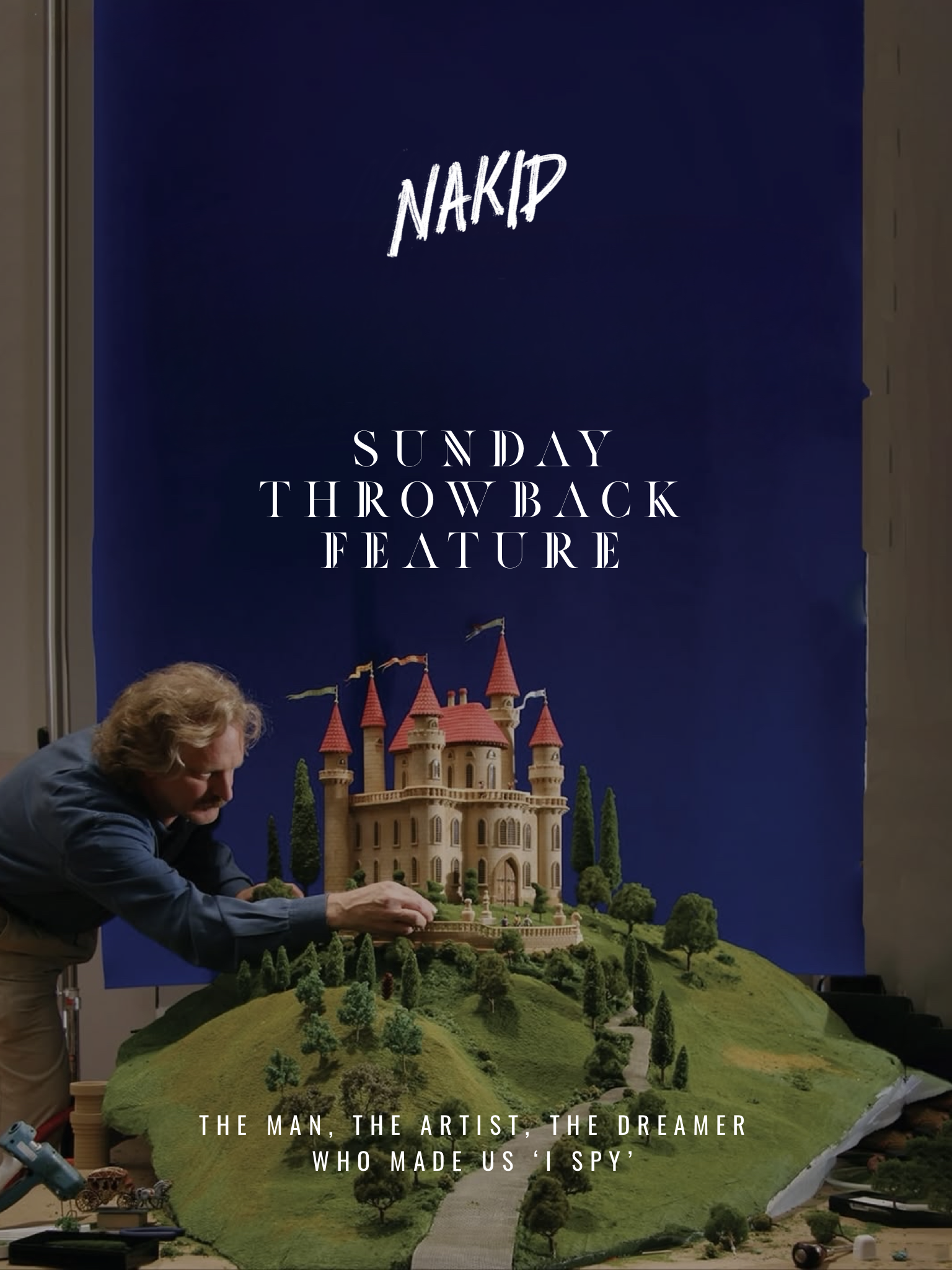
Before kids had iPads to scroll through or endless YouTube rabbit holes to dive into, there were picture books that felt like entire universes waiting to be explored. For a whole generation, those universes were built by Walter Wick. With a camera, a patient eye, and the obsessive precision of a magician setting up a trick, Wick turned tables piled with toys, marbles, and mirrors into sprawling dreamscapes of mystery.
His I Spy pages weren’t just pictures, they were riddles in disguise. A child could get lost in them for hours, combing through clutter that suddenly wasn’t clutter at all, but a stage. Every domino, bead, feather, or rubber band was arranged with intention, lit just so, photographed until the mundane became enchanting. The fun was never just about finding the object; it was about noticing the beauty hidden in chaos, the magic in the everyday.

Images © Walter Wick, courtesy of Scholastic Inc. and the New Britain Museum of American Art.
When I Spy launched in 1992, it was an immediate phenomenon. The words, written by Jean Marzollo, rhymed like little spells. The images, painstakingly built and shot by Wick, turned household junk into mythology. Each page could involve hundreds of objects, carefully sourced from flea markets, toy shops, nature walks, and thrift bins. Sometimes he would spend weeks just building the set. In one famous case, the “Levers, Ramps, and Pulleys” spread, Wick created a functioning balloon-popping machine. The page didn’t just look mechanical; it was mechanical, engineered in miniature.

Images © Walter Wick, courtesy of Scholastic Inc. and the New Britain Museum of American Art.
That’s part of what made Wick’s work so radical: he treated children not as passive readers but as curious detectives. He gave them entire dioramas where the rules of space and logic could be bent, but always with internal consistency. If a marble rolled, the ramp worked. If a mirror doubled an object, the reflection obeyed light. He wanted kids to question how they saw as much as what they saw.

Images © Walter Wick, courtesy of Scholastic Inc. and the New Britain Museum of American Art.
Wick’s fascination with seeing, and seeing differently, goes back to his own beginnings. Born in Hartford, Connecticut, he studied photojournalism at Paier College of Art, but what grabbed him wasn’t reporting: it was illusion. He once described how a picture of a soccer goal reflected in a puddle made him rethink photography as not just a tool for documenting reality but for bending it. That curiosity about perception is what led him away from commercial photography and into building worlds from scratch.
Over time, I Spy became more than books; it was a cultural training ground. Teachers used the spreads in classrooms, parents used them to quiet restless kids, and libraries couldn’t keep the volumes on shelves. After Jean Marzollo passed in 2018, her sons Dan and Dave picked up the mantle, writing the rhymes for new books like I Spy Love (2024), while Wick kept crafting the visual puzzles. The collaboration that began as two artists’ experiment in the early ’90s now spans generations.

Images © Walter Wick, courtesy of Scholastic Inc. and the New Britain Museum of American Art.
Wick’s influence hasn’t been confined to the printed page either. Museums like the New Britain Museum of American Art have mounted exhibitions such as Walter Wick: Hidden Wonders! where fans can see not only the final photographs but also the physical models he built in his studio. One standout display features “Space Station Impossible” from Can You See What I See? Shown both as a finished image and as the three-dimensional model. From one angle the model looks incomplete, from another it resolves perfectly, proof that perspective is its own kind of trick.

Images © Walter Wick, courtesy of Scholastic Inc. and the New Britain Museum of American Art.
Even today, Wick’s process remains analog in spirit, even if the tools are modern. He starts with sketches, builds elaborate sets often with help from model-makers like Randy Gilman, and then spends days finessing lighting until every reflection, shadow, and highlight feels alive. Each photograph is both a riddle and a reward: proof that play and art can be indistinguishable when you take them seriously enough.

Images © Walter Wick, courtesy of Scholastic Inc. and the New Britain Museum of American Art.
Long before attention spans were atomized by feeds, Wick understood something about how humans see: that delight comes not just from spectacle but from discovery. His books trained a whole generation to slow down, scan carefully, and find joy in the overlooked. He made clutter holy, and in doing so, taught millions of kids that the world is always hiding more than it shows.

Images © Walter Wick, courtesy of Scholastic Inc. and the New Britain Museum of American Art.

Images © Walter Wick, courtesy of Scholastic Inc. and the New Britain Museum of American Art.

Images © Walter Wick, courtesy of Scholastic Inc. and the New Britain Museum of American Art.

Images © Walter Wick, courtesy of Scholastic Inc. and the New Britain Museum of American Art.