
Why the film industry is blaming streaming for a cultural shift it refuses to confront
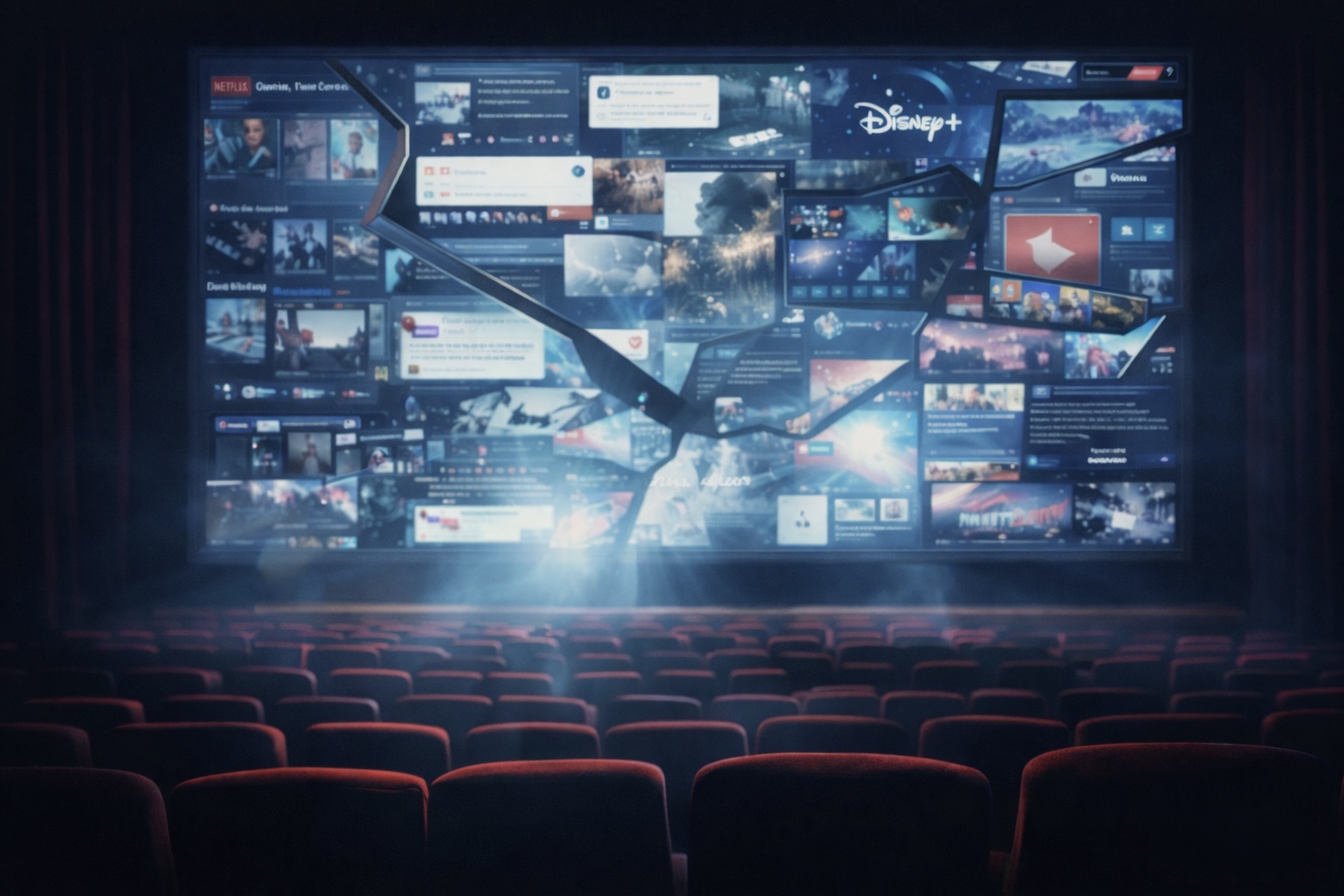
There is a comforting narrative circulating through Hollywood right now. Executives repeat it at conferences, studio strategists present it in polished slide decks, and industry analysts echo it in trade publications as though repetition alone might make it true. The idea is that the theatrical experience can be restored to its former cultural dominance if films simply stay in theaters longer before arriving on streaming platforms. According to this logic, audiences have been conditioned to stay home because movies reach services like @Netflix too quickly, and the solution is to stretch the theatrical window so people feel compelled to return to cinemas again.
The argument sounds clean, rational, and almost comforting in its simplicity. The only problem is that it feels like a false equivalency. It assumes the collapse of theatrical attendance is primarily a distribution problem when the deeper issue appears to be cultural behavior itself. The way people engage with entertainment has changed dramatically over the last fifteen years, and the idea that a few additional weeks before streaming will reverse that transformation feels less like strategy and more like wishful thinking.
We are living in a period where sustained passive attention is increasingly rare. The idea of sitting in a dark room for three hours without touching a phone, responding to messages, checking notifications, or interacting with anything outside the screen has become surprisingly difficult for many people. Even at home, watching a film rarely exists as a single isolated activity anymore. It happens alongside texting, browsing, or scrolling through some parallel stream of information. The modern media environment encourages constant engagement, constant input, and constant interaction.
You cannot force people to want what you want them to want.
Extending theatrical windows might slow the bleed a little, and it might produce a marginal bump in early ticket sales for certain types of films, but pretending that two or three extra weeks of theatrical exclusivity will somehow restore cinema attendance to pre streaming levels ignores the broader cultural shift that has already taken place. What it actually resembles is an attempt to delay a slow decline rather than confront the deeper structural changes shaping how audiences experience entertainment.
Hollywood still tends to operate under a monolithic cultural assumption about storytelling. The assumption is that audiences should want to sit quietly in a room for two or three hours, surrender their attention completely, and experience a narrative exactly as it was designed to be experienced. That ritual defined cinema for more than a century, and when it works it remains one of the most powerful artistic experiences ever invented. Watching a film in a theater at its best can feel almost sacred, a collective moment where hundreds of strangers share the same emotional arc together.
The problem is that rituals only survive when the surrounding culture continues to support them. Right now culture is evolving in ways that increasingly undermine that particular ritual.
Last summer I was traveling through Europe and found myself in Rome with a free evening, so I decided to see a movie at a local theater. I expected the usual experience, a dark room, a large screen, and a temporary escape into someone else’s story. About halfway through the film something happened that completely shattered the illusion. The lights came on, the screen faded, and a ten minute commercial break started playing in the middle of the movie. The audience barely reacted because they were accustomed to it, but the interruption immediately destroyed the immersive spell the film had built up to that point. When the movie resumed the emotional continuity was gone. The images were still there and the dialogue continued as if nothing had happened, yet the narrative energy never recovered because the experience had already been fractured.
Moments like that illustrate how fragile the theatrical experience actually is. Hollywood executives often frame the conversation as a battle between theaters and streaming platforms such as @Netflix, but the reality is more complicated. Theaters themselves share responsibility when the environment begins eroding the very qualities that once made cinema special. Excessive advertising, inflated concession prices, declining projection standards, and disruptive audience behavior all contribute to the gradual erosion of the experience. When the ritual itself becomes frustrating or compromised, audiences do not analyze the situation philosophically. They simply stop showing up.
If something like mid film commercial breaks ever became normalized in the United States, theaters would collapse almost instantly because the uninterrupted immersion of cinema is the entire reason people leave their homes in the first place. Once that immersion disappears, the justification for the theater disappears with it.
Sometimes I like to run thought experiments about where the world might be heading. Imagine for a moment that it is the year 2050. Ignore artificial intelligence for now and focus only on the pace of technological change and the patterns of human attention. Look at how young people today interact with media and consider how those behaviors might evolve over the next twenty five years. This generation already struggles to sit through long stretches of passive viewing without interacting with a phone or another device. By 2050 the technology competing for their attention will almost certainly be far more immersive, far more integrated, and far more addictive than the smartphones we carry today.
Technology consistently evolves toward interaction. It rewards engagement, personalization, and constant feedback loops. Passive observation becomes harder to sustain in an ecosystem designed to stimulate continuous participation. That trend does not mean storytelling disappears, but it does suggest that the forms storytelling takes will continue to evolve alongside the technologies shaping audience behavior.
There is also a scenario where broader economic changes dramatically expand the amount of time people spend consuming entertainment. If automation and technological displacement eventually lead to something like widespread universal basic income, millions of people could suddenly have more free time than any generation before them. In that world the creative industries might explode with new energy because both creators and audiences would have more time to explore art, film, and storytelling.
Even in that optimistic future, however, there is no guarantee that traditional theatrical cinema would once again dominate cultural life. Film itself would likely evolve in response to the environment around it. Storytelling might become more interactive, more immersive, or more participatory in ways that blur the line between viewer and participant.
Hollywood often resists that possibility because it challenges a long standing belief about authorship. Filmmakers like to imagine they control the entire experience. They frame every shot, design every sound cue, and orchestrate every emotional beat with precision. Yet culture ultimately determines how art is consumed, not the artists who create it.
As filmmakers and storytellers we do not get to dictate how audiences must experience our work. Our responsibility is to observe how the world is changing and adapt our methods accordingly. The goal is not to force the public back into an older ritual simply because it once worked. The goal is to find new ways to capture attention, curiosity, and wonder in the cultural environment that actually exists.
Clinging to a rigid distribution model while hoping audiences will magically return to it is not a strategy. It is nostalgia disguised as policy.
This entire situation reminds me of something much smaller and much more personal. I love shooting on film whenever I am working in the real world. Over the years I have collected more than a hundred cameras, some of them beautiful mechanical machines that feel like tiny pieces of industrial sculpture. Shooting film forces you to slow down and think carefully about every frame, and there is something deeply satisfying about the tactile relationship between photographer and camera.
But those cameras are also temperamental. Sometimes a shutter sticks. Sometimes the film jams. Sometimes you hear the mechanical hesitation that tells you the shot you just took might not exist at all. When that happens you do not have the luxury of arguing with the camera about how things used to work. You either adapt immediately or you lose the moment forever.
In practice that means reaching for another tool. You pull out a digital backup or another camera and keep shooting because capturing the moment matters more than preserving the exact method you originally imagined. The result might feel slightly different, but the story survives because you were willing to adapt.
Hollywood needs to learn the same lesson.
If the primary camera keeps jamming, insisting that it remain the only acceptable option is not a strategy. Backup tools may feel unfamiliar, but they offer flexibility, speed, and entirely new creative possibilities. The objective is not to preserve the exact same cinematic ritual forever. The objective is to keep storytelling alive and evolving in whatever form allows it to survive.
Until the industry begins confronting the world as it actually is, rather than the world it nostalgically remembers, the conversation about theatrical windows will remain what it is now, a temporary delay applied to a much larger cultural shift.
Leave a Reply