
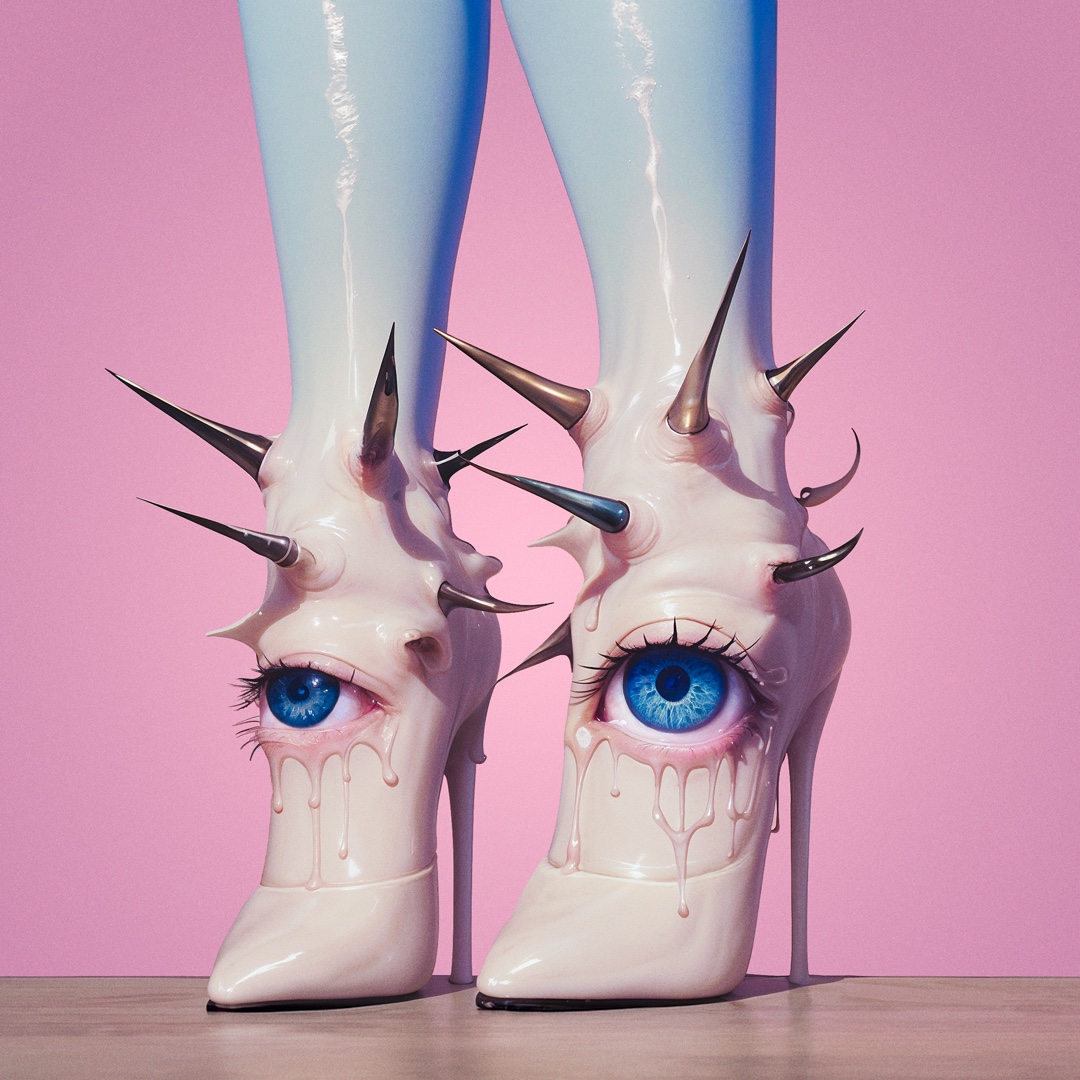
CRAFTING SILENCE, LIGHT, AND AI INTO A SURREAL MINIMALIST LANGUAGE OF HIS OWN
There’s a reason your thumb hesitates when a MACBETH image slides into view. The scroll stops. Time flattens. Clean lines cut through the feed like a scalpel. Stark silhouettes whisper like secrets held in backrooms. There’s a geometry at play—a kind of quiet violence laced with cinematic detachment and just enough unstable dream logic to leave you wondering if you’re seeing something real or hallucinating a vibe. That’s the trap. That’s when he’s already in your bloodstream. You’ll find him as @minimal_macbeth and @macbethAI, but don’t bother trying to draw a line between them. These aren’t alter egos. They’re timestamps in a fluid metamorphosis, an evolution from surgical minimalism into full-bodied AI surrealism with a pulse you can’t ignore.
MACBETH didn’t erupt out of the void. This isn’t some overnight algorithmic apparition. Like the most vital artists coming up now, his work comes from the trenches, those deep, chaotic corners of digital life where clarity only comes when you start stripping things down to the bone. Early on, under the minimalist banner, @minimal_macbeth hit us with images that felt like meditations on absence: clean, unnerving, quiet in a way that made the world feel too loud. It was visual restraint as rebellion. But that was just the opening act. With the rise of AI, the gloves came off. @macbethAI stepped onto the stage like a weapon forged in the storm of a new creative order. His aesthetic didn’t shift—it evolved, mutated, fed on machine intelligence and came back hungrier. He didn’t flinch at the future. He seduced it. And for those bold enough to move early, to experiment loud while others hesitate, there’s an entire goldmine waiting in the niche he’s carving with surgical precision.

Scrolling through MACBETH’s feeds is like falling into the trailer of a film that never existed but somehow still shaped you. The frames are familiar like déjà vu. Still images that echo the ghosts of stories you never lived but somehow remember. It’s that same feeling you got wandering through a Blockbuster as a kid, haunted by a VHS cover you swear you saw once but could never find again—just flashes of visual memory: a silhouette in impossible light, rooms too big for logic, architecture that felt like cathedrals built for dreams. His work doesn’t just sit pretty in your feed. It scores the moment. You can almost hear it. Like it should be wrapped in synths or whispered voiceovers. That’s the real trick, MACBETH doesn’t just create visuals, he builds sensations. His pieces don’t settle for being seen. They demand to be felt. They climb into the space behind your eyes and linger there, addictive, impossible to shake.
And the wildest part? He’s not even playing the game. While most AI artists claw at the hype cycle with noise and neon and maximalist chaos, MACBETH’s lane is carved with stillness. It’s discipline as defiance. Where others turn up the volume, he dials it all the way down—and still steals the room. He understands that minimalism isn’t the absence of something, it’s the presence of intent. Every piece he drops is a lesson in tension, in letting silence speak louder than screams. His visuals whisper, and somehow, they land like thunder. In a digital world where everything is fighting for your attention like a tantrum, MACBETH reminds us that the quiet ones might just be the ones that save you, not literally, but emotionally. And that might be more important. Because when a creator transcends the tool, it’s no longer about tech—it’s about truth. And that’s rare. That’s MACBETH.

It makes perfect sense that MACBETH would slide into the NFT and crypto-art world without flinching. His work doesn’t just fit the medium, it demands it. These are pieces that deserve permanence, that feel more like relics from some parallel digital mythos than just content on a feed. When he mints a piece, it’s not just another drop, it’s a migration. From scrollable ephemera to collectible identity. For most people, that world’s already faded into a cautionary tale of hype burnout and broken wallets. But for MACBETH, it’s just another dimension to explore. Not a cash grab. A canvas.
His link-in-bio isn’t just a list of platforms. It’s a constellation. A living map of how digital identity mutates and expands when an artist treats each space, Instagram, X, NFT marketplaces, not as endpoints, but as conversations. It’s a portfolio, sure, but also a manifesto. A proof-of-evolution where audience becomes part of the process, where community and creation bleed into each other until you can’t tell where the art ends and the ecosystem begins. MACBETH isn’t just building visuals. He’s architecting presence. And in a digital age flooded with noise, that kind of intentionality isn’t just refreshing.. it’s revolutionary.

What sets MACBETH apart isn’t just the visual discipline, it’s the control. The confidence. The refusal to hand over authorship to the machine, even as he collaborates with it. In a digital climate bloated with “AI slop,” where lazy generics drown out genuine vision and the looming threat of lawsuits hangs like smog, MACBETH’s work slices through with intention. It feels authored. Designed. Directed. Like cinema in still form, not just style porn or algorithmic collage. And that’s no accident. It takes clarity. It takes a spine. It takes someone who sees AI not as a shortcut or a spectacle, but as a partner in crime.
We sat down with MACBETH for NAKID’s Artist to Watch series, diving into the why and how: how he threads minimalism with emotion, why he sees AI as a collaborator rather than competition, and what it means to build cinematic imagery in a space that hasn’t even settled on its own grammar yet. The result? A conversation about process, presence, and the power of slowing things down in a culture obsessed with speed.

EXCLUSIVE INTERVIEW /. MACBETH
Designed space or story frame?
Honestly, I just build visuals I want to get lost in. Sometimes they’re stories, sometimes they’re just nice images to stare at.
Shift from minimal_macbeth to macbethAI?
I dropped the minimal_ part because I definitely don’t only create “minimal” things. I’ve been on a maximalism still-image kick for over a year now. Also I’ve fully embraced AI into my workflow, might as well own it.
Lawsuits, exclusivity, marketing pawns — where is AI art headed?
Platforms will do what platforms always do, squeeze artists. We’ll just keep making and find better corners of the internet to do it in.

Algorithm vs. self-expression?
Algorithms are like casinos. I bring my chips to the table and walk away. Basically I create for both depending on my mood and explorations.
NFTs, ownership, hype cycle?
NFTs were never just JPEGs; they were proof of community. The market cooled, but digital ownership isn’t going away. The next version will look less like speculation and more like infrastructure.
AI killing creativity vs. democratizing it?
Every tool that lowered the barrier to entry was once called “the death of art.” The camera, Photoshop, now AI. If your work has no soul, that’s not the tool’s fault.

Avoiding AI slop?
Curation and editing is key. I delete 90% of what I make so the remaining 10% has space to breathe.
Unexpected influences lately?
Bugs, desert landscapes. Will be exploring Texas and Arizona for the first time this fall. Its subliminally showing in my work now.
Next experiment?
I’m building a whole series around Cults/Cabals/Religions that aren’t just videos/images, but something between a ritual and a game. I want to make art that messes with you, like you’ve got to solve it just to see it all

Warning label?
Question everything
Most reckless thing for art?
Hiking with a 20k camera setup (no bag) just to get a bald eagle shot.
Minimalism in art, maximalism in life?
Polished: True. My browser tabs are maximalism.
Raw: Yeah, my hard drive is chaos.

AI apocalypse, your worlds as wallpaper?
I want people to feel both safe and uneasy, like a dream you’re not sure you want to wake up from.
One thing nobody’s saying in the AI conversation?
Concert visuals, this seems like a major untapped market.
What are you trying to make people feel when they experience your work?
A mix of calm and unease. Like you’ve wandered somewhere sacred but slightly wrong.
If your art had a physical form or sound, what would it be?
A slow-moving synth drone inside a concrete hallway.
How has technology changed your sense of authorship or intuition in the creative process?
It taught me to let go. The AI machine throws curveballs I’d never think of, and I just follow the weird ones.
What do you think the future of art will feel like, not just look like?
Less watching, more experiencing. It’ll mess with your senses, not just your eyes.
What three music artists are inspiring you right now?
George Clanton, Fever Ray, and random Dub Techno mixes on YouTube
What’s the weirdest or most unexpected thing that inspired this piece, and what is your favorite part of making it?
It’s from nights just drifting around Japan; pachinko noise, neon signs, tiny bars, no real destination. That weird in-between feeling when it’s too late to go home but too early to sleep.
What’s one visual or sonic memory that shaped who you are as an artist?
Seeing SE7EN as a kid completely changed how I thought about visuals. The dirty textures, those amazing jittery opening credits with NIN music, all that detail. It wasn’t about the story, it was how everything looked.
FOLLOW MACBETH AND HIS WORK HERE!
